|
Kangra Tea – The Golden Brew
By Aparna Datta
It’s a tea like no other. It’s important to appreciate this right at the start: far too often, Kangra tea is compared to Darjeeling to get a frame of reference. But, it’s different, and Kangra fully deserves to be recognized as a distinct origin.
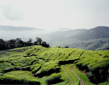
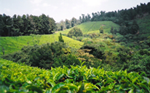
Kangra district is situated in the North-West Indian state of Himachal Pradesh. This is mountain country, very much part of the Himalayas with dramatic landscapes ranging from pine tree-covered slopes to frozen high-altitude deserts and deep gorges with bubbling streams that flow into the Ganges river of India, and the Indus river in Pakistan. The state shares a border with Punjab to the west, Kashmir to the north, and on the east side has Tibet as a neighbour. The craggy Dhauladhar range towers over the Kangra Valley, where in the foothills lies India’s smallest tea region with its own tea town of Palampur.
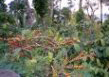
Uniquely, it’s the only tea region in India that comprises exclusively China, or China-hybrid, tea bushes. Historical records say that Dr Jameson, then Superintendent of the Botanical Gardens in Peshawar, now in Pakistan, visited the Kangra district in 1849, and pronounced that the lower slopes of the Dhauladhar range lying between 900 and 1400 metres were ideal for tea cultivation. The first commercial plantation was established at Holta near Palampur in 1852 at an elevation of 1260 metres above sea level. The seeds for planting were largely obtained from China and by 1892 the area under tea extended over 9,000 acres, with plantations owned by Europeans as well as native proprietors. The Gazetteer of Kangra district recorded in 1882-83 that “The tea now made is probably superior to that produced anywhere else in India. The demand has been steadily increasing and much is now bought by natives for export via Peshawar to Kabul and Central Asia.” Kangra tea reached European markets through London, Barcelona and Amsterdam and even won gold and silver medals at exhibitions in European capitals during 1886-95.
Disaster stuck in 1905 when the Kangra Valley was devastated by a great earthquake, from which the tea region, in a sense, has never fully recovered. Tea factories lay in ruins, tea growing areas were destroyed, forcing European pioneer planters to make distress sales and leave the valley now perceived as unsafe, handing over the estates to either their workers or local traders. With the facilities for black tea production disrupted, green tea output became the norm – fortuitously, one may say, as the China variety tea leaves are eminently suited to the making of green tea. Over the years, Kangra green tea developed its own franchise, and was much in demand in Kashmir and Afghanistan till war and political strife took its toll in the late 20th century. Overland transit routes have been cut, and the tea trade dwindled even further after the tea auction center at Amritsar in the neighbouring state of Punjab went into liquidation in 2005.
Quite unlike the organized tea planting that exists in Darjeeling, Assam and the Nilgiris, the Kangra tea district, which includes select areas of Chamba and Mandi districts of Himachal Pradesh (HP), today literally survives against all odds. Dominated by small growers – 96% of growers have holdings of less than two hectares – tea growing here is more of a cottage industry. Labour is hard to come by, with much of the plucking done by migrant labour from the plains. Land holdings have fragmented over the years as families split up units as inheritance. Lower prices for tea have prompted growers to diversify their cultivation to include cash crops such as rice and potatoes and tea is seen as a side income. The problems get compounded by low productivity and low yields due to poor bush management. Currently, the tea acreage is estimated at 2312 hectares with practically half the area considered either neglected or abandoned.
Support for the industry came from the state government of HP which assisted in the setting up of four cooperative tea factories at Bir, Palampur, Baijnath and Sidhbari during the period 1964-1983. Since small growers lack the financial capacity to set up their own factories, they are encouraged to supply the green leaf to the coop factories, which process and market the made tea. Sadly, by year 2002, only the Palampur tea factory was functional, while the others shut down as operations became economically unviable.
Just when it seemed that Kangra would become a footnote in tea history, the Tea Board of India stepped in to facilitate change. On the one hand, small growers were given financial assistance and training, and on the other hand, large growers were encouraged to invest in the region. P Chhetri, Assistant Development Officer at the Tea Board regional office at Palampur, himself a native of Darjeeling and exposed to tea all his life, invited tea professionals from other areas to visit the region and support the local industry.
A significant venture formed as a result of such intervention is Manjhee Valley, promoted by A.K. Singh, a veteran tea entrepreneur, and his son Kunal Singh who handles marketing based in New Delhi. In 2003, the HP government leased the Sidhbari co-op tea factory to the Singhs, who brought in professional supervision, and have now effectively managed a turnaround in operations. Guidance to tea pluckers and higher standards for green leaf, quality control during processing and market development has changed the very trajectory of the Kangra tea industry, such that Kangra tea is once again being exported to international markets such as USA. Recently, the Baijnath co-op tea factory was given on lease to Tewari and partners in March 2006, who are now marketing Kangra teas under the brand name ‘Himtea’.
Other private tea enterprises have also seen positive growth over the last couple of years. Wah Tea Estate, established in 1857, perhaps the only large tea plantation and factory that survives intact from the early days, and owned since 1953 by Sheoparshad Jaiprakash & Co., of Kolkata, has seen its fortunes improve through a judicious mix of orthodox black and green tea production. With access to speciality tea buyers in Kolkata, Wah is able to capitalize on the inherent strengths of the Kangra leaf and produces high-end teas that stand out on any tasting table. Remarkably, reasonable investments, care and nurture of tea gardens can achieve wonders, and between them, Manjhee Valley, Wah Tea Estate and the Dharamsala Tea Company, have proved that Kangra tea is indeed highly marketable.
Kangra tea is quite naturally a speciality tea. The China leaf, when processed according to quality norms, yields a distinctive brew that’s gold in colour, with a sweet undertone and none of the astringency associated with Darjeeling teas. Kangra tea appeals to the Western palate as it is best when taken neat, without milk or sugar. That’s a downside for local Indian markets, but an upside for consumers in Europe, US and Japan. Interestingly, the liquid remains clear and the colour remains stable, even with second and third extracts, so much so that the tea adapts perfectly to ready-to-drink and iced teas. Kangra tea can be consumed several times right through the day, without any caffeine overload, because it is so smooth and mellow.
All Kangra tea is produced by orthodox manufacture, and given the traditional manner of cultivation and frugal inputs, the region is by default organic. The more remote tea areas in the region retain vestiges of the past, a quaint living tea museum dotted with vintage Britannia and Marshall orthodox tea rollers, made by 19th century English tea equipment manufacturers, that still turn out a good twist!
Some of the small growers in Kangra are third generation planters and keep the family tradition alive, because “my grandfather grew tea and it’s what I’ve seen since I was a child.” The processing methods haven’t changed much either – Kangra is the only tea region in India where hand rolling of tea is still in vogue – green tea is produced by both by the steam as well as the pan roasting method and patiently handcrafted.
Far from the commercial tea growing and marketing centers in the rest of India, the Kangra tea region has a certain rustic charm. With its unique planting heritage and distinct cup character, Kangra tea has great potential and yearns to be rediscovered and suitably valued. The very pristine nature and limited production could yet be an advantage as tea buyers seek out this hidden treasure in the Himalayas. Plans are underway for a Kangra Tea Festival in May 2007 to be organized by Kangra Valley Small Tea Planters Association with support from the Tea Board and other local stakeholders. Speciality tea buyers in particular will revel in exploring what may be termed the final frontier of the tea world: Kangra, one of the oldest, yet newest of tea origins.
IHBT
The cause of Kangra tea has received strong support from the Institute of Himalayan Bioresource Technology (IHBT) at Palampur, a unit of the Council of Scientific & Industrial Research (CSIR) of the Government of India. It provides R&D services to aid rejuvenation of neglected tea gardens in the region, tea husbandry, breeding of high-yielding tea varieties, biotechnology for quality improvement and comprehensive advisory services to tea growers. IHBT’s research efforts have backed up the application for Geographical Indication (GI) status for Kangra tea, and the institute has developed specific technologies for ready-to-drink teas including tea concentrates for black and green tea, and even tea wine! Technology transfer is possible under CSIR guidelines.
For more information, visit: http://teanorthwestindia.org
© Aparna Datta, 2006
Published in Tea & Coffee Asia magazine, 3rd Quarter 2006
|