Wah Tea Estate,
Kangra
When a tea estate gives its year of establishment
as 1857, it truly merits respect as an historic estate. Wah
Tea Estate in Kangra was set up in the backdrop of the War
of 1857, also known as the Sepoy Mutiny, in a watershed year
that changed Indian history forever, as the British Raj consolidated
its dominion.
In the late 1850s and early 1860s, tea estates were sprouting
up around India, all as independent initiatives in different
regions. In 1859, Thiashola was set up in the Nilgiris by
employing Chinese prisoners of war; Dunsandle also in the
Nilgiris, was set up around that time. In Darjeeling, Makaibari
was established in 1859, while Ambootia was set up in 1861.
The first seedlings for the Darjeeling and Nilgiri estates
came from China; though Darjeeling has retained much of the
China variety bushes, the Nilgiris has moved onto other hybrids.
Tucked away in the Himalayan foothills in Himachal Pradesh
state in India is Kangra district, where tea took root after
Dr Jameson, then Superintendent of the Botanical Gardens in
Peshawar in the North West Provinces, on a visit in 1849,
declared that the district was right for tea cultivation.
Seedlings were brought in from China and the first estate
was set up in 1852. The second half of the 19th century saw
a small, but thriving tea industry take shape in Kangra. Importantly,
till today, this region, now largely forgotten, remains 100
per cent China tea bush country, yielding tea with a distinct
cup character. In its hey day, Kangra was the tea of choice
in Afghanistan and Central Asia, and even reached Europe and
USA.
Kangra tea fell off the map when a devastating earthquake
struck the region in 1905 and badly disrupted the industry.
European planters left the region, handing over their estates
to their workers or local traders. Starved of capital and
improvements in cultivation and processing, this tea region
today struggles to survive, although the Himachal Pradesh
government as also the Tea Board of India have made several
attempts to support the growers. Today, there are just a handful
of private tea estates, in an area where small growers comprise
96 per cent, holding an average of 2 hectares each. The total
area under tea in Kangra is around 2300 hectares, grown at
elevations ranging from 900 to 1500 metres.
Which is why Wah Tea Estate, with a continuous history of
cultivation since 1857, deserves all the attention it can
get. The name Wah derives from Wah in Pakistan – the
first owner was the Nawab of Wah whose family sold out and
left after the Partition. In 1953, the estate was taken over
by Sheoparshad Jaiprakash & Co., of Kolkata.
In a vivid demonstration of the several lives a tea plantation
can have, Wah, in the last couple of years has seen remarkable
revival thanks to capital investments and direct supervision
by the owners. Today, this estate produces both orthodox black
and green tea at quality standards that would satisfy the
most discerning buyers.
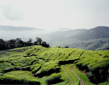
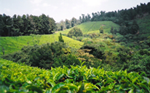
Kangra is tranquil and unpolluted, where the pine-scented
air is said to have curative powers. With a mix of tropical
and sub Himalayan varieties, oaks and majestic cedars ride
the crest of every hill. The Dhauladhar range of mountains,
part of the Himalayas, rise dramatically from the foothills
and provide a serene backdrop to the tea town of Palampur.
Nearby is Dharamsala, the district headquarters of Kangra,
which is the residence of His Holiness the Dalai Lama and
a second home for more than eight thousand Tibetan refugees.
Some of the old colonial flavour lingers in the stone church
of St. John in the Wilderness, where the British Viceroy,
Lord Elgin, is buried. Sir Francis Younghusband – leader
of British India’s fateful incursion to Lhasa has Kangra
(Dharamsala) connections. His parents lived in a bungalow
in a pine forest and later bought land in the Kangra Valley
to pioneer a tea plantation. Robert Shaw was a renowned explorer
and an early Kangra tea planter.
The bounty of water and the unique climate – cool breezes
laden with moisture from the snows and warm sunshine have
given Kangra its tea gardens. Water abounds here – the
streams are full of life.
Why should the world care if Kangra tea survives? Because
it lends diversity to India’s basket of teas, and provides
a choice for Western tea buyers looking to improve their repertoire.
Support from buyers is what is needed to bring Kangra tea
back into the world tea map. Wah Tea Estate, as a leading
light of the district, is all set to reclaim its destiny.
Contact: Wah Tea Estate, P.O. Palampur, Dist Kangra, Himachal
Pradesh, INDIA
Email: wahtea@gmail.com; Contact Person: Deepak Prakash
Phone No: 9831158666 / 91-33-32939693
- PENSCAPE
|