The Kanan Devans
“…the extensive and salubrious
range of mountains and valleys which are known by the name
Kanan Devan Hills…where the delicious climate, pure
water and healthy life, really make life worth living…”
This excerpt from an article published in “The Mail”
of Madras dated 8th April 1892, holds true even today.
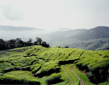
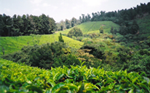
Munnar in the High Range, also known as the Kannan Devan
hills in Kerala state, India is quintessentially a tea town
and home to the Kanan Devan Hills Plantations Company Private
Limited (KDHP). While Munnar is located at an altitude of
4,900 ft., the surrounding areas go up to over 7,000 ft.,
producing high-grown teas. The highest peak in India south
of the Himalayas, the Anaimudi (8,841 ft.) is in the High
Range. It is here that the Kurinji flower blossoms once in
twelve years, covering the hills with a beautiful azure mantle,
with the next blossoming scheduled in 2006.
In 1877, the local Poonjar prince owing allegiance to the
Maharajah of Travancore leased out a tract of land, measuring
588 sq. km., known as the Kanan Devan Concession Land. It
became the base for the Kanan Devan Hills Produce Company
established in 1897, which together with the other subsidiaries
of the Glasgow-based Finlay Group opened 33 estates in the
High Range. In 1964, a collaborative venture between the James
Finlay Group and the Tata Group, a leading Indian conglomerate,
was initiated to develop value-added teas; later, in 1983,
James Finlay sold out to the Tatas. In March 2005, in an historic
development, Tata Tea Limited divested its share in the South
India Plantations Operations and handed over 17 estates to
KDHP, a company formed by ex-employees of Tata Tea, resulting
in one of the largest participatory management firms in the
world.
Blessed with high altitude and high rainfall, the High Range
produces exquisitely tangy and aromatic teas. The Chundavurrai
tea factory can process nearly one lakh kg of green leaf per
day, and is considered to be the largest orthodox tea factory
in the world.
Pullivasal Estate situated in the High Range is where India’s
poly pack revolution started. The automated tea packeting
center on this estate was established by Tata Tea Ltd., in
1983 and was the first unit to package garden-fresh tea in
poly packs under the Kanan Devan brand name. This ushered
in a major change in tea packaging and marketing, bringing
down prices, and expanding consumer choice.
India’s first tea museum is located at the Nullatanni
estate in Munnar. Set up by Tata Tea in March 2004, it is
now managed by KDHP.
This tea district co-exists peacefully with the adjoining
Eravikulam National Park, which is wedged between the High
Range and the Anamallais, covering about 105 sq. km of undulating
virgin grasslands and wooded valleys. Originally a part of
the Concession Land, the area became a sanctuary under the
Kerala State Government in 1981 and was declared a National
Park in 1978. This Park is perhaps the only one of national
stature in the world where private estate managers of KDHP
are involved in the administration of the Park through the
High Range Wildlife & Environment Preservation Association,
and together with the Kerala Forest Department and the local
Muthuvans is engaged in Joint Forest Management of the Eravikulam
sanctuary. This Park is also a refuge for the endangered Nilgiri
tahr: of the total tahr population in India, the maximum numbers
are found here.
- PENSCAPE
|