Eco-tourism:
where less is more
By Aparna Datta
To get to the Devbagh Beach Resort at Karwar, you have to
take a three-kilometer boat-ride. Check into you room: a log
hut on stilts with a thatched roof…
At the B.R. Hills Wildlife Adventure Resort at K.Gudi you
have a choice: furnished tents or huts on stilts lit only
by hurricane lamps, or the Maharaja’s bungalow with
electricity…
Camp out on the banks of the River Cauvery at the Cauvery
Fishing Camp at Bheemeshwari. Go angling for mahseer –
snare a 100 pounder, get yourself photographed, and promptly
release the game fish back into the river…
Welcome to the world of the eco-tourist. Individualistic
and independent, they seek experiences literally off the beaten
track. A new breed of traveler keen on visiting remote getaways
that offer an enlightening nature travel experience that contributes
to conservation of the eco-system while respecting the integrity
of host communities. This is alternative tourism – far
removed from Club Med or the Dubai Shopping Festival.
It’s a growing trend, and implies a paradigm shift
in the tourism industry. Catering to this new customer requires
taking a fresh look at the design and the amenities provided
at such resorts.
The hospitality industry has always referred to hotels and
resorts as properties. The image that comes to mind is that
of chrome and glass, spacious lobbies, mood lighting, extensive
landscaping. The accent is on constructed space, and imposing
facades.
At resorts subscribing to the new mantra of Eco-tourism,
the concept is just the opposite. The accommodation is designed
to blend with the environment, making use of locally available
building materials. In fact, a specific design aesthetic characterizes
such resorts, with the term property being a misnomer, because
planners totally avoid any construction that might seem artificial.
The Casino Group (CGH Earth) in Kerala is making waves –
its Coconut Lagoon resort has been listed by the Conde Nast
Traveller as one among 25 of the world’s most remote
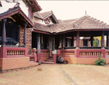
and exotic hideaways. Its specialty is the accommodation in
Tharawads – traditional ancestral Kerala houses made
of wood which have actually been recreated using century-old
materials, guided by experts in the Thachu Shastra school
of carpentry. The bathing area is open to sky. The entire
experience is altogether novel and memorable.
In Karnataka, Jungle Lodges and Resorts Ltd., a unit of Karnataka
Tourism, has blazed a new trail. Over the past ten years,
the Company has turned losses into profits, and emerged as
a front-runner in the Eco-tourism business. Starting with
the Kabini River Lodge, they have now developed four new resorts,
offering a wide range of activities.
It has patented a concept called the Gol Ghar, a gazebo which
is open on all sides and serves as a community dining space.
Care is taken to provide modern toilets; other than that,
few concessions are made for other creature comforts, i.e.,
no satellite TV! Cleanliness, hygiene, eco-friendliness –
yes; discos and wild parties – no.
Writes Ikarus Tours of Germany, “We have experienced
a very interesting place in the wilderness, not being spoilt
like others.”
Developing a resort in a remote location presents its own
set of challenges. Says Vinay Luthra, Executive Director of
Jungle Lodges and Resorts (JLR), “We are committed to
socially and environmentally responsible tourism.” Such
development cannot be imposed – it has to integrate
with the existing socio-economic profile of the region. Moreover,
development has to enhance the quality of life of the local
population. JLR hands over 10 per cent of its profits to local
villages for use in social amelioration schemes.
At Devbagh, a Village Forest Committee has been constituted
to ensure that the development activities do not disrupt the
lives of the villagers. All those displaced by the creation
of the resort are rehabilitated to the extent possible –
villagers are trained for new jobs, their skills employed
for making furniture, decorative and souvenir items for the
resort.
Such concerns add a new dimension to project development.
For the Taj Group, dealing with these issues starts at the
concept stage. E Kumar, General Manager (Projects) confirms
that Environmental Impact Assessments are routinely carried
out for all projects. For resorts in forests and protected
areas, such scrutiny holds special relevance, and ensures
that only eco-friendly features will be incorporated. Ergo,
no air-conditioning and now swimming-pools in sanctuaries!
Worldwide, environmental awareness has stimulated greater
efforts to promote sustainable tourism. Green Flag International,
a not-for-profit concern based in the UK, works in partnership
with the tourism industry. Through a rating scheme, it audits
holiday packages, tour operators and resorts, looking at criteria
such as:
- Consideration given to landscape, wildlife and cultural
heritage
- Waste disposal and recycling
- Interaction with local communities in terms of goods
and services
- Sympathetic building and architecture
The Green Flag approach has introduced independent product
performance and testing, evaluation and accountability.
For architects and interior designers Eco-tourism represents
a whole new idiom in resort development. It means understanding
the needs of a niche customer, and incorporating aspects into
the design that complement the natural habitat. It means a
special sensitivity to the environment, maintaining a fine
balance between man and nature. The guideline could simply
be: “Less is more.”
The reward would come in guest comments such as this made
by Louise Nickleson, a travel writer from the UK, about the
Kabini River Lodge. “This is paradise…a re-charging
of wonderful memories to be savoured slowly until the next
visit. May the place never change.”
© Aparna Datta, 1998
Published in Assets – Property pages
of the Times of India, Bangalore, April 9,
1998
|