|
Prayers to Plague Amma
By Aparna Datta
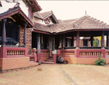
On Friday mornings, a remote corner of Thyagarajanagar in south-west Bangalore takes on a special significance. Scores of women make their offering to the deity at the Raja Rajeshwari or Plague Amma temple.
One has heard of goddesses for cholera or small-pox and HIV-AIDS in other parts of India, but this is perhaps the only temple in the world to be dedicated to the goddess of plague. How did ‘Pilague-amma’ find a congenial abode in Bangalore?
Legend has it the Mother’s blessings cured thousands of inhabitants of Blackpalli, what we now know as Shivajinagar, from the scourge of the plague. That’s why thousands of devotees throng St Mary’s Basilica in Shivajinagar during the annual St Mary’s Feast. A hundred years on, memories of the holocaust have dimmed, but the temple survives to tell the tale, as much as the church-lore does at St Mary’s.
The Plague in Bangalore was, in a way, transmitted through the railways. The ‘Karnataka State Gazetteer’ edited by Suryanath Kamath, records that a butler of a railway officer brought the infection from Hubli and died on August 15, 1898. It became an epidemic that spread to the Palace area, Balepet, Ulsoor, Lalbagh and was concentrated in Blackpalli in the Cantonment area. The death toll peaked in November 1898, but sporadic outbreaks continued up to the turn of the century. It actually resulted in a decline in population in Bangalore to the tune of 25 per cent – over 30,000 people left the old city in a year.
Then the government took over. A chief plague office was appointed to head anti-plague operations. The city was divided into four wards and prizes were awarded to those who killed rodents. People were asked to vacate their houses in the city and live in segregation camps. Dis-infection was undertaken. Check-posts were created at railway stations and along arterial roads leading to the city. Passengers coming from infected places had to be dis-infected when they alighted.
Things got so systematic that telephone lines were laid and used on a wide scale in the city to coordinate anti-plague operations!
The epidemic, it turned out, provided an impetus to the development of Bangalore. New amenities, like sanitation and health facilities, were added.
New extensions like Malleswaram and Basavangudi were created. Hotels were opened to feed the Cantonment officers, whose families were sent back home. The drainage system improved and houses that were left deserted after deaths were demolished, thereby reducing congestion. Regulations were issued for building new houses with proper facilities for sanitation and ventilation. The city came to have a health officer from 1898, and in 1900, the Victoria Hospital was inaugurated by Lord Curzon, the then Viceroy.
The misery caused by the deaths, segregation and other measures made a strong impact, however, and left its mark on the psyche of the people, turning them anti-government. Yet, the growth and development of modern Bangalore can actually be traced back to the defining event of the plague.
Today, the Plague Amma temple has a new lease of life with the additional appellation of Raja Rajeshwari. Devotees continue to worship the goddess, and pooja has been offered at the temple without a break these last hundred years. In its own way, the temple remains a monument to sanitation and hygiene with much contemporary relevance.
Going by what’s happening around the city today, who knows when the goddess may need to be appeased again…
The advent of Naale Baa
In 1898-99, a plague struck Bangalore, and carried off about 3500 people in the old Mysore State. It was a major catastrophe that changed the face of Bangalore. Maya Jayapal, in her book Bangalore – The Story of a City, writes that the temple was set up to propitiate the grama devatha or village deity, for many believed that it was the wrath of the goddess that brought about scourges such as the plague. In an attempt to divert the attention of the goddess, people would write on the doors of their houses, ‘Plague Amma, naale baa (Plague Amma, come tomorrow).
© Aparna Datta
Published in Bangalore Times / Times of India, October 6, 1998
|