|
From Mocha to Mysore: A Coffee Journey
By Aparna Datta
COFFEE: Arab, kahwa, a word which appears to have been originally a term for wine… the derivation of the word has been plausibly traced to Kaffa, one of those districts of the S. Abyssinian highlands which appear to have been the original habitat of the coffee plant. It is said to have been introduced into S. India some two centuries ago by a Mahommedan pilgrim, named Baba Budan, who brought a few seeds with him from Mecca: see Rice, Mysore. – From Hobson-Jobson first published in 1886.
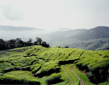
India’s contribution to world coffee lore is the story of ‘Baba Budan and the Seven Seeds’. Sometime during the late 17th century, Baba Budan rallied the faithful in front of a holy cave in the Chandragiri Hills in Chikmagalur to challenge a murderous chieftain, who had entrenched himself in the hills, and with his hordes was devastating the country. The ‘Poligar’ and his men perished. Baba Budan announced to his followers that he had decided to go on a pilgrimage to the Holy City of Mecca, and disappeared into the cave. All through the long weary months his faithful followers, both Hindu and Muslim, waited at the mouth of the cave till the holy man reappeared. He told them the glad news that he had brought from the Holy Land as a gift for them, seven seeds of a wondrous plant which would serve as “food and drink” for them. These seeds were planted on the Chandragiri Hills, which from that day came to be known as the Baba Budan Hills.
What the followers weren’t told, of course, is that Baba Budan had smuggled the seeds from Yemen, “strapped to his belly”! The legend of Baba Budan identifies India as an ‘origin’ and lends substance to the antiquity of India’s coffee growing traditions.
But, what about the consuming tradition?
’Twas in the 16th century that the coffee bean first landed in India, borne on trading vessels that plied between the Konkan and Malabar coast and the Red Sea ports. John Keay, in his book titled The Honourable Company – A History of The English East India Company, mentions Yemen (in 1608) as having extensive plantations of coffee. ‘The seeds of this cohoo is a great marchandise for it is carried to Grand Cairo and all other places of Turkey and the Indias.’ For some 200 years, till 1750, the Yemeni port of Mocha held a monopoly on coffee, with the authorities jealously guarding its transit.
Rev. Edward Terry, chaplain to Sir Thomas Roe who was ambassador at the court of Emperor Jehangir, provides a detailed account of its usage (1616): “Many of the people there (in India), who are strict in their Religion, drink no Wine at all; but they use a Liquor more wholesome than pleasant, they call Coffee; made by a black Seed boyld in water, which turnes it almost into the same colour, but doth very little alter the taste of the water: notwithstanding it is very good to help Digestion, to quicken the Spirits, and to cleanse the Blood.”
The French jeweler, Jean Baptiste Tavernier, who traveled through India around 1676, writes, “Coffee grows neither in Persia nor in India. Nevertheless, some vessels load up with it on their return from Mecca…”
The East India Company brought in fresh influences. David Burton, a food historian based in New Zealand writes in his book The Raj at Table (1993) “India’s first coffee house opened in Calcutta after the battle of Plassey in 1780. Soon after, John Jackson and Cottrell Barrett opened the original Madras Coffee House, which was followed in 1792 by the Exchange Coffee Tavern at the Madras Fort. The enterprising proprietor of the latter announced he was going to run his coffee house on the same lines as Lloyd’s in London, by maintaining a register of the arrival and departure of ships, and offering Indian and European newspapers for his customers to read. Other houses also offered free use of billiard tables, recovering their costs with the high price of one rupee for a single dish of coffee.”
“And of course we have a Coffee-shop! We gather together every morning after the early ride of parade, to refresh the exhausted frame with copious libations of Mocha and Bohea… with the aid of coffee and cheroots, newspapers, and perhaps a game at billiards, we while away the fleeting hour…” So writes George Francklin Atkinson in his hugely entertaining Curry and Rice on Forty Plates – The Ingredients of Social Life at “Our Station” in India, published in 1859.
By the middle of the 19th century, coffee was being served at the many clubs that sprouted around India, the first being the Bengal Club in Calcutta 1827, followed soon after by the Madras Club in 1832 and the Bangalore Club in 1863. With the hill stations being set up in the north and in the south, and British administration extending to the mofussil areas, coffee drinking also spread. Victorian style made it an after-dinner ritual, and coffee became de rigueur at many a banquet.
Commercial planting of coffee started around 1820, with the Mysore government liberally handing out ‘puttahs’. Interestingly, even in the coffee planting districts, tea remained the beverage of choice for the early morning drink, while coffee was taken during breakfast. Cathleen Ballantyne, who came to Coorg in 1880, writes, “On a coffee estate, the day began early. At six-thirty, one was wakened by the clanging of the estate bell… At the same hour, the early cup of tea materialized for the dorai and doraisanny. Then at seven, out on the verandah, chota hazri – a substantial meal of porridge, eggs and bacon, coffee and fruit.”
So, just when and how did coffee, thus far an Arab/Muslim/European experience, percolate into the south Indian, and particularly, the Tamil Brahmin household? Literature and anecdotal evidence provide some clues, as evoked in this extract from the novel Devadasi by Kasturi Sreenivasan, under Chapter I – The Course of True Lovers (1877):
Outside the temple, the petty vendors along the dusty street were doing a brisk trade by the light of smokey oil lamps...
Though Palayam was only a small town, one of its eating places started serving a new drink called coffee. It had been introduced by the British rulers and there were many stories about it. Some argued that, since it was of European origin, it must necessarily be unclean; others said it might be alcoholic. In any case, very few tried it, since a tumbler full cost as much as half an anna, while butter-milk was served free in many places and coconut water including the tender coconut meat was only a paisa. Only the most daring or the wealthy could afford the exotic brew. There was animated conversation about this and about various other things among the men who were slowly gathering in the temple courtyard. They talked about a new thing called a railway which had just been extended to the town from Madras recently...
By 1860, coffee cultivation in the Western Ghats had gained momentum, and by the late 19th century, it may be assumed that apart from the coffee destined for export, some bags of coffee found their way into the domestic market. Facilitated by the railways and orchestrated by enterprising local traders and vendors, coffee moved from road-side stalls into the Tamil home, finding aficionados who roasted their own beans – peaberry preferably – and devised their own unique gadgets and utensils for roasting, grinding, brewing and serving. In the process, they elevated filter coffee into an art form and created a coffee culture that practically defines a community.
Leo Coffee owes its inception in 1910 to P R K Nadar, when the Little Flower and Santa Maria Estates in the Palani hills, run by missionaries, asked for help in selling coffee in the local market. Narasu’s started operations in 1919, and by 1929 had established a large roastery at Salem. Both catered to the almost insatiable appetite for coffee amongst upper-class Tamilians, a tradition vividly expressed by R K Narayan in The Vendor of Sweets. In 1924, Mavalli Tiffin Rooms set up shop at Lalbagh Fort Road, Bangalore, and out-of-home coffee got a new dimension.
Indian filter coffee even migrated overseas in the early 20th century to Malaysia and Singapore, where kopi tarik (pulled coffee) is a close cousin of the Madrasi coffee-by-the-yard/metre, and was introduced at roadside kopi tiams run originally by Indian Muslims.
Alongside, another phenomenon in the shape of the Udupi café took root. First in Bombay, and then progressively throughout the country, the magical kaapi, along with idli, vada, dosa and sambhar, found yet another band of devotees – as can be seen to this day at Mysore Café, Matunga.
The first India Coffee House opened on Churchgate Street in Bombay on 28th September 1936. Much like the coffee houses of Europe, the India Coffee House quickly became a rendezvous for the intellectual and the dilettante alike. At the height of its glory, the India Coffee House chain, operated by the Coffee Board, numbered 72 outlets, and essentially introduced the coffee habit in the tea-drinking north of the country.
A fresh new aroma wafted in during the 1990s, with a whole new trend in coffee retailing in India. Coffee bars today capture the spirit of the age, the Café Coffee Day on Brigade Road, Bangalore being the first ‘cybercafe’ in the country. Café Coffee Day, Qwiky’s and Barista now have a national presence, and cater largely to young adults. These trendy bars serve a variety of beverages and snacks, with the espresso counter being a focal element. The contemporary coffee bar scene, comprising the coffee chains besides a host of independent outlets, spells non-stop excitement!
Today, glitzy coffee bars in urban centers coexist with darshinis, coffee at home is both instant and filtered, found on tap at vending machines and served at five star hotels. But for the original full-bodied Indian filter coffee, one still has to hit the pilgrim trail. It’s places like Madurai and Kumbakonam, Udupi and Mysore that serve coffee that’s sheer ambrosia.
There’s this Tamil Brahmin yuppie, who daily hops on to the New Jersey commuter train juggling cellphone, organiser and a cup that’s emblazoned with the logo of a famous US coffee company. The twist in the tail? The cup contains filter coffee, brewed just the way his grandma would make it back home in Madras. Some old habits die hard!
© Aparna Datta, 2004
Published in Tea & Coffee Asia magazine 1st Quarter, 2004
|